
 Subject Comment
Iran’s drone attacks on Azerbaijan may initially appear to be a routine retaliation in the war. However, looking at the background of the incident, it becomes clear that this attack is not merely a military move; it is part of a broader strategic game stretching from the Middle East to the Caucasus.
The Iran-US-Israel war, which began at the end of February 2026, is being waged not only on the front lines but also behind the scenes. Iran’s attack targeting the area around the airport in the Nakhchivan Autonomous Republic is seen as one of the first signs of this shadow war extending to the Caucasus. Official statements describe the attack as a “retaliation.” However, Tehran’s real message is deeper: Azerbaijan is no longer just a neighbor for Iran, but is seen as a potential Israeli outpost.
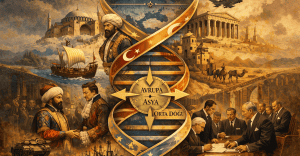
The Genetics of Turkish Foreign Policy
Okumak istersen →There has been a claim circulating in Tehran for years: that the logistical routes for some of Israel’s operations against Iran are established through Azerbaijan. Israel’s intensive arms sales to Baku and the military cooperation between the two countries constantly fuel this suspicion. Iranian security circles consider the possibility that Azerbaijani territory could one day be used for air operations against Iran to be a serious risk.
However, the issue is not only military. The millions of ethnic Azeris living in northern Iran have always been a sensitive topic in Tehran’s strategic calculations. Considering that the number of Azeris in Iran is estimated to be close to 10 million, Azerbaijan’s strengthening or moving closer to the Western axis is not just a foreign policy issue for Tehran; it also means a potential internal security risk.
Therefore, according to some analysts, the attack on Azerbaijan is not just a military message; it is also a warning that “I can open a new front in the Caucasus.”
Iran’s war strategy is taking shape precisely at this point. Rather than confining the conflict to a single front, Tehran is attempting to spread it across a wider geography, forcing the US and Israel into a more dispersed struggle. The drone and missile attacks targeting Gulf countries, Jordan, and American bases in Iraq are part of this strategy. But what is striking is this: Iran is keeping these attacks measured and limited. The goal is not to cause massive destruction, but to wear down the other side’s defense systems and scatter their resources.
When external actors are added to this picture, the real chessboard of the war becomes clearer.
The positions of Russia and China are particularly noteworthy. Although both countries have strategic partnership agreements with Iran, they have not taken a direct role in the war. Moscow is already carrying a heavy military burden due to the war in Ukraine. Although it has provided Iran with technology transfers or support in terms of defense systems, direct involvement in the conflict is a risky option for the Kremlin.
China’s stance is more complex. Beijing prefers to wait rather than openly defend Iran. This is not only because it wants to remain neutral. For China, Iran means a cheap and dependent partner in energy supply in the long term. Iran’s complete collapse could be a bad scenario for China; however, Iran remaining weak and in conflict with the West could also serve Beijing’s energy and geopolitical calculations.
Therefore, some analysts point to the most striking paradox of the war:
Although Iran is officially a strategic partner of Russia and China, it is effectively alone at the critical moment of the war.
It is also unlikely that Iran would benefit from an escalation of the war. A scenario such as the closure of the Strait of Hormuz could drive up oil prices. However, such a crisis would also target Iran’s infrastructure and increase economic pressure.
Moreover, the Iranian economy, which has been under sanctions for a long time, is not in a position to bear the cost of war. In an environment where drone and missile stocks are rapidly depleting, internal opposition is strengthening, and allies are not providing concrete support, a prolonged war could pose a serious risk to the regime.
This whole picture reveals the unseen side of the war:
The struggle unfolding in the Middle East is not only between Iran and Israel. It is also a proxy chess game played by major powers without directly confronting each other.
And on this chessboard, a drone attack on Azerbaijan may not be just a minor move; it could be the first sign that the Caucasus has also been drawn into this great game.