 Subject Comment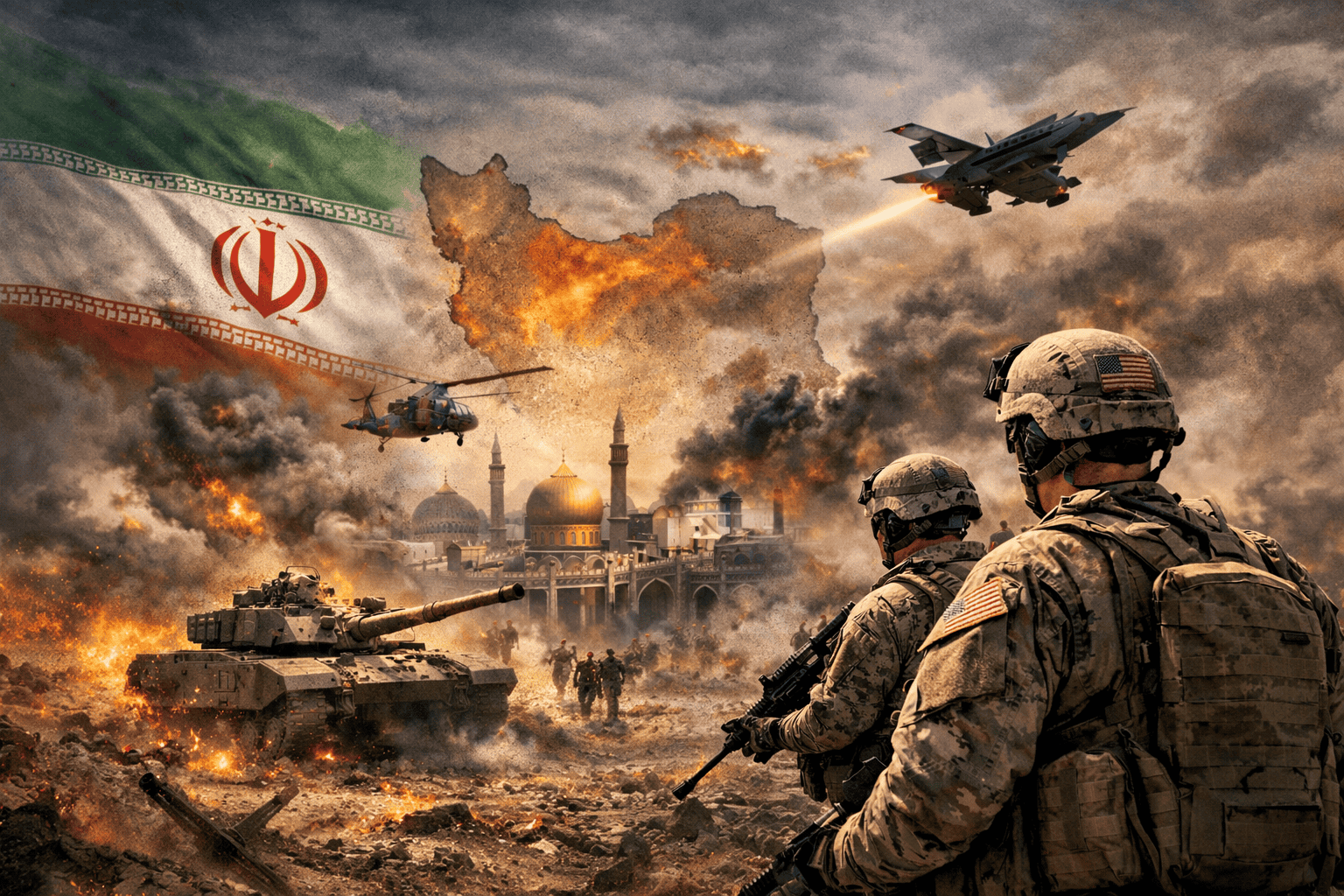
The rapidly escalating tension between the United States, Israel, and Iran has once again raised a crucial question: how far could this war go? As of March 2026, the military campaign carried out by the United States and Israel against Iran—known as “Operation Epic Fury”—has so far been limited mainly to air and naval strikes. These attacks, targeting Iran’s nuclear and military infrastructure, indicate that the conflict has not yet moved into the phase of a ground invasion.
Official statements from Washington support this assessment. President Donald Trump and Defense Secretary Pete Hegseth have stated that sending U.S. ground troops into Iran is “not on the table at the moment.” However, the typical caution in American diplomatic language remains: never say never.

The Genetics of Turkish Foreign Policy
Okumak istersen →In other words, while a ground invasion does not appear to be part of the current plan, it has not been completely ruled out either.
The current U.S. strategy appears to focus less on a traditional occupation and more on applying military pressure on the regime while encouraging internal opposition forces. Heavy airstrikes, cyber operations, and economic pressure are being used together to weaken Iran militarily and potentially trigger internal political fractures. After all, a full-scale ground invasion of a country as large as Iran would involve enormous military, logistical, and political costs.
What Happens If Ground Troops Enter Iran?
If the United States were to deploy ground troops in Iran, the nature of the war would change dramatically. Rather than leading to a rapid regime collapse, such a scenario would more likely produce a long and complex conflict.
Iran’s geography plays a major role in this equation. The country consists of vast deserts, rugged mountains, and difficult terrain that would be extremely challenging to control. Past experiences in Afghanistan and Iraq have demonstrated how such environments can turn into prolonged wars of attrition for invading forces.
Moreover, Iran’s power does not rely solely on its national army. Tehran maintains a wide network of regional proxy forces—including Hezbollah, the Houthis, and various Shiite militias—capable of expanding the conflict far beyond Iran’s borders. In such a case, the war could spread from Lebanon to Yemen, drawing Gulf states, Israel, and potentially even actors in South Asia into a wider regional crisis.
This type of escalation would also have serious consequences for the global economy. Any disruption to energy flows—particularly through the Strait of Hormuz—could sharply increase oil prices and trigger a new wave of global economic instability.
Could Iran’s Army Withstand U.S. Ground Forces?
In terms of conventional military power, Iran faces a clear technological disadvantage compared with the United States. Iran’s ground forces—estimated at around 350,000 troops—rely heavily on older Soviet-era equipment and domestically produced systems. In contrast, the U.S. military possesses advanced drone capabilities, satellite-supported intelligence, modern armored units, and overwhelming air support.
However, wars are not decided by technology alone. Iran’s defense doctrine is largely built around asymmetric warfare. Guerrilla tactics in mountainous terrain, extensive minefields, ballistic missile attacks, and naval disruption operations could impose significant costs on U.S. forces.
Some military analyses suggest that a full-scale invasion and occupation of Iran could require more than 500,000 American troops. Such a deployment would represent an enormous logistical and political undertaking.
As a result, any ground war in Iran would likely evolve not into a quick victory, but into a prolonged war of attrition.
What If the U.S. Suffers Heavy Losses?
If the United States were to suffer heavy casualties in Iran, the consequences would extend beyond the battlefield. A scenario involving thousands of American military deaths could provoke a serious political backlash within the United States.
It could also revive something similar to the “Vietnam syndrome,” a psychological and political reluctance within American society toward large-scale foreign military interventions.
The financial cost would also be immense. A prolonged war or large-scale occupation could cost the United States trillions of dollars. Rising oil prices, global inflation, and expanding military spending could also limit Washington’s ability to allocate resources to other strategic priorities—particularly its long-term competition with China.
That said, the United States possesses enough military and economic capacity to recover over time. Nevertheless, the political and geopolitical costs of such a war could prove far deeper than its purely military consequences.
In short, the current situation suggests that Washington prefers a strategy based on air power and limited operations rather than a full-scale ground invasion. A land war remains one of the most risky and costly options available.
Yet history repeatedly reminds us of one reality in Middle Eastern conflicts:
wars that begin as limited operations can quickly spiral into much larger confrontations.